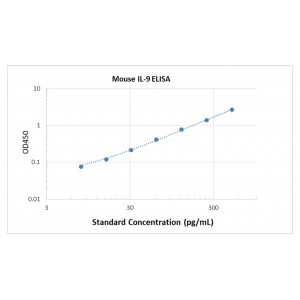
Description
Assay Format
Sandwich ELISA.
Storage
Store at 4 °C.
Expiration
12 months at 4 °C.
Range
7.8 pg/mL – 500 pg/mL.
Sensitivity
4.3 pg/mL.
Specificity
No detectable cross-reactivity with any other cytokine.
Application
cell culture supernatants, serum and plasma.
Kit Components
1. Lyophilized recombinant Mouse IL-9 standard: 500 pg/tube-2.
2. One 96-well plate precoated with anti-Mouse IL-9 antibody.
3. Sample diluent buffer: 12 mL -2
4. Biotinylated anti-Mouse IL-9 antibody: 60µL, dilution 1:180.
5. Antibody diluent buffer: 12ml.
6. Streptavidin-HRP: 300µL, dilution 1:40.
7. Streptavidin-HRP diluent buffer: 12ml.
8. Chromogen-A, 6 ml; Chromogen-B, 6 ml.
9. Stop Solution: 6ml.
Data Sheet
| Alternate Names | HP40; IL9; IL-9; IL-9homolog of mouse T cell and mast cell growth factor 40; interleukin 9; interleukin-9; p40 cytokine; p40 T-cell and mast cell growth factor; P40; T-cell growth factor P40 |
| Assay Range | 7.8 – 500 pg/ml |
| Background | Interleukin 9, also known as IL-9, is a pleiotropic cytokine (cell signalling molecule) belonging to the group of interleukins.IL-9 is produced by variety of cells like mast cells, NKT cells, Th2, Th17, Treg, ILC2, and Th9 cells in different amounts. Among them, Th9 cells are regarded as the major CD4+ T cells that produce IL-9.
Il-9 is a cytokine secreted by CD4+ helper cells that acts as a regulator of a variety of hematopoietic cells.This cytokine stimulates cell proliferation and prevents apoptosis. It functions through the interleukin-9 receptor (IL9R), which activates different signal transducer and activator (STAT) proteins namely STAT1, STAT3 and STAT5 and thus connects this cytokine to various biological processes. The gene encoding this cytokine has been identified as a candidate gene for asthma. Genetic studies on a mouse model of asthma demonstrated that this cytokine is a determining factor in the pathogenesis of bronchial hyperresponsiveness. |
| Gene ID | 16198 |
| UniProt ID | P15247 |