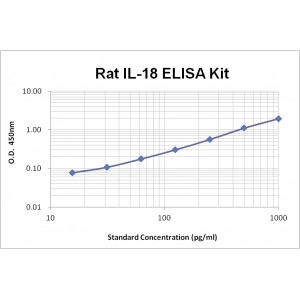
Description
|
Assay Range |
15.6-1,000 pg/mL |
|
Sensitivity |
1.0 pg/mL |
|
Size |
96T |
|
Storage |
Store at 2 – 8ºC. Keep reconstituted standard and detection Ab at -20 ºC |
|
Assay Principle |
Sandwich ELISA |
|
Sample Volume |
100 µL final volume, dilution factor varies on samples |
|
Detection Method |
Chromogenic |
Kit Components
1. Recombinant Rat IL-18 standard: 2 vials
2. One 96-well plate coated with anti- Rat IL-18 Ab
3. Sample diluent buffer: 12 mL – 1
4. Detection antibody: 130 µL, dilution 1:100
5. Streptavidin-HRP: 130 µL, dilution 1:100
6. Antibody diluent buffer: 12 mL x1
7. Streptavidin-HRP diluent buffer: 12 mL x1
8. TMB developing agent: 10 mL x1
9. Stop solution: 10 mL x1
10. Washing solution (20x): 25 mL x1
Background
Interleukin-18 (IL-18), also known as IL1-F4 and IFN-γ inducing factor (IGIF), is a member of the IL-1 family. Rat IL-18 precursor protein is composed of a 36 amino acid (aa) propeptide and a 158 aa mature region. Under inflammatory conditions, the propeptide is removed by Caspase-1 in the cytoplasm to release the mature nonglycosylated monomeric form of IL-18. Mature rat IL-18 shares 91% and 60% aa sequence identity with mouse and human IL-18, respectively. IL-18 is a secreted protein from a variety of cell types including macrophages, dendritic cells, and epithelial cells. Circulating mature IL-18 is sequestered and inactivated by soluble IL-18 binding proteins (IL-18BP). The IL-1 family member IL-1F7 binds IL-18BP and enhances its inhibitory effect on IL-18 activity. IL-18 binds to its receptor IL-18Rα which then recruits the signaling subunit IL-18Rβ. IL-1F7 also binds to IL-18 Rα but does not recruit IL-18Rβ or induce signaling. IL-18 activates NK, Th1, and Th17 cells and increases the production of IFN-γ by collaboration with other cytokines. In cancer, IL-18 attracts Th1 and NK cells to target tumor cells, in the meanwhile, it also promotes angiogenesis, metastasis, and tumor cell immune evasion.