Description
|
Assay Range |
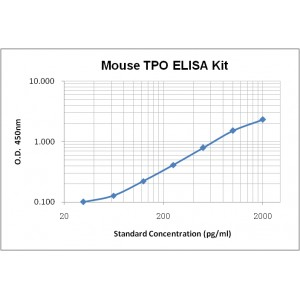
31.2-2,000 pg/mL |
|
Sensitivity |
5.0 pg/mL |
|
Specificity |
No cross-reaction with other related substances detected |
|
Size |
96T |
|
Storage |
Store at 2 – 8ºC. Keep reconstituted standard and detection Ab at -20 ºC |
|
Assay Principle |
Sandwich ELISA |
|
Sample Volume |
100 µL final volume, dilution factor varies on samples |
|
Detection Method |
Chromogenic |
Kit Components
1. Recombinant Mouse TPO standard: 2 vials
2. One 96-well plate coated with Mouse TPO Ab
3. Sample diluent buffer: 12 mL – 1
4. Detection antibody: 130 µL, dilution 1:100
5. Streptavidin-HRP: 130 µL, dilution 1:100
6. Antibody diluent buffer: 12 mL x1
7. Streptavidin-HRP diluent buffer: 12 mL x1
8. TMB developing agent: 10 mL x1
9. Stop solution: 10 mL x1
10. Washing solution (20x): 25 mL x1
Background
Thrombopoietin (Tpo), also known as megakaryocyte growth and development factor (MGDF), C-mpl ligand (ML), Megakaryocyte colony-stimulating factor, myelo- proliferative leukemia virus oncogene ligand, is a protein encoded by the c-Mpl proto-oncogene in humans. The mouse Tpo is synthesized as a 356 amino acid (aa) precursor protein containing a 21 aa signal peptide and a 335 aa mature protein with an erythropoietin (Epo) domain in the N-terminus, a serine, threonine and proline rich domain, as well as seven potential N-linked glycosylation sites at the C-terminus. Tpo is expressed predominantly in adult and fetal liver, kidney and bone marrow stromal cells.
Tpo (c-mpl) is a member of the cytokine receptor superfamily. Two cDNA clones encoding the transmembrane receptor and a soluble form of the receptor have been isolated from mouse cells. Tpo plays an important role in regulating the proliferation and maturation of megakaryocytes from their committed progenitor cells.