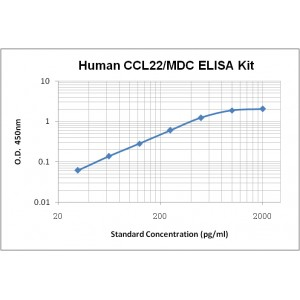
Description
|
Assay Range |
31.2-2,000 pg/mL |
|
Sensitivity |
1.0 pg/mL |
|
Specificity |
No cross-reaction with other related substances detected |
|
Size |
96T |
|
Storage |
Store at 2 – 8ºC. Keep reconstituted standard and detection Ab at -20 ºC |
|
Assay Principle |
Sandwich ELISA |
|
Sample Volume |
100 µL final volume, dilution factor varies on samples |
|
Detection Method |
Chromogenic |
Kit Components
1. Recombinant Human CCL22 standard: 2 vials
2. One 96-well plate coated with Human CCL22 Ab
3. Sample diluent buffer: 12 mL – 1
4. Detection antibody: 130 µL, dilution 1:100
5. Streptavidin-HRP: 130 µL, dilution 1:100
6. Antibody diluent buffer: 12 mL x1
7. Streptavidin-HRP diluent buffer: 12 mL x1
8. TMB developing agent: 10 mL x1
9. Stop solution: 10 mL x1
10. Washing solution (20x): 25 mL x1
Background
Macrophage-derived chemokine (MDC), also known as C-C motif chemokine 22 (CCL22), CC chemokine STCP-1, small-inducible cytokine A22, or stimulated T-cell chemotactic protein 1, is a member of the CC chemokine family. MDC is a 69 amino acid (aa) small chemokine. It shares less than 35% aa sequence identity with other human chemokines and is 65% identical to the apparent mouse homolog, ABCD-1 (Activated B cell and dendritic cell-1). MDC is constitutively expressed in dendritic cells, B lymphocytes, and macrophages, while it is inducible in NK cells, monocytes, and CD4+ T lymphocytes in response to stimuli of IL-4 and IL-13.
MDC is a ligand for the G protein-coupled chemokine receptor CCR4. MDC exhibits chemotactic activity in macrophages and dendritic cells which show little or no CCR4 expression, suggesting that alternate receptor(s) occur.