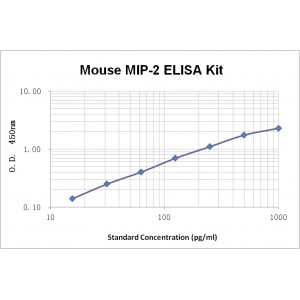
Description
|
Assay Range |
15.6 – 1,000 pg/mL |
|
Sensitivity |
5.0 pg/mL |
|
Size |
96T |
|
Storage |
Store at 2 – 8ºC. Keep reconstituted standard and detection Ab at -20 ºC |
|
Assay Principle |
Sandwich ELISA |
|
Sample Volume |
100 µL final volume, dilution factor varies on samples |
|
Detection Method |
Chromogenic |
Kit Components
1. Recombinant Mouse MIP-2 standard: 2 vials
2. One 96-well plate coated with Mouse MIP-2 Ab
3. Sample diluent buffer: 12 ml— 2
4. Detection antibody: 130 µL, dilution 1:100
5. Streptavidin-HRP: 130 µL, dilution 1:100
6. Antibody diluent buffer: 12 mL x1
7. Streptavidin-HRP diluent buffer: 12 mL x1
8. TMB developing agent: 10 mL x1
9. Stop solution: 10 mL x1
10. Washing solution (20x): 25 mL x1
Background
Macrophage Inflammatory Protein-2 (MIP-2), also called macrophage inflammatory protein 2-alpha (MIP2-alpha), Growth-regulated protein beta (Gro-beta) and Gro oncogene-2 (Gro-2), chemokine (C-X-C motif) ligand 2 (CXCL2), is a small cytokine belonging to the CXC chemokine family. Mouse MIP-2 is synthesized as a 100 amino acid (aa) precursor protein containing a 27 aa signal peptide and a 73 aa mature polypeptide. Mouse MIP-2 shares approximately 63% sequence identity to mouse KC, another member of mouse CXC chemokines. Both mouse KC and MIP-2 bind mouse IL-8 Rβ with high affinity. Mouse MIP-2 also exhibits 60% sequence identity to human MIP-2. MIP-2 is secreted by monocytes and macrophages and plays a chemotactic role in polymorphonuclear leukocytes and hematopoietic stem cells. It has been suggested that the mouse KC and MIP-2 are functional homologs of human IL-8 in mice.
| µL |