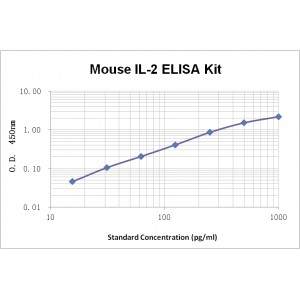
Description
|
Assay Range |
62.5–4000 pg/mL |
|
Sensitivity |
10.0 pg/mL |
|
Size |
96T |
|
Storage |
Store at 2 – 8ºC. Keep reconstituted standard and detection Ab at -20 ºC |
|
Assay Principle |
Sandwich ELISA |
|
Sample Volume |
100 µL final volume, dilution factor varies on samples |
|
Detection Method |
Chromogenic |
Kit Components
1. Recombinant Mouse CD26 standard: 2 vials
2. One 96-well plate precoated with anti-Mouse CD26 Ab
3. Sample diluent buffer: 12 mL – 1
4. Detection antibody: 130 µL, dilution 1:100
5. Streptavidin-HRP: 130 µL, dilution 1:100
6. Antibody diluent buffer: 12 mL x1
7. Streptavidin-HRP diluent buffer: 12 mL x1
8. TMB developing agent: 10 mL x1
9. Stop solution: 10 mL x1.
10. Washing solution (20x): 25 mL x1.
Background
Dipeptidyl peptidase-4 (DPP4), also known as adenosine deaminase complexing protein 2 or CD26, is a type II membrane protein encoded by DPP4 gene in humans. DPP4 is composed of a short cytoplasmic tail, a transmembrane domain, and a long extracellular domain with several glycosylation sites, a cysteine-rich region and the catalytic active site. The extracellular domain of mouse DPP4 is 84% and 91% identical to the human and rat counterparts, respectively. The natural occurring DPP4 exists as a non-covalently linked homodimer on the cell surface of diverse cell types. The soluble form is also detectable in human serum and other body fluids.
DPP4 is a serine exopeptidase that cleaves X-proline dipeptides from the N-terminus of polypeptides. A wide range of proteins have been identified as DPP4 substrates including growth factors, chemokines, neuropeptides, and vasoactive peptides. DPP4 has exhibited multiple biological activities. For instance, it functions as T cell-activating molecule (THAM) and a cofactor for entry of HIV in CD4+ cells. It is responsible for the degradation of incretins such as GLP-1. It acts as a suppressor in the development of cancer and tumors and is a potentially useful biomarker for various cancers. It binds adenosine deaminase, the deficiency of which causes severe combined immunodeficiency disease in humans. It degrades procalcitonin, a marker for systemic bacterial infections with elevated levels detected in patients with thermal injury, sepsis and severe infection, and in children with bacterial meningitis.