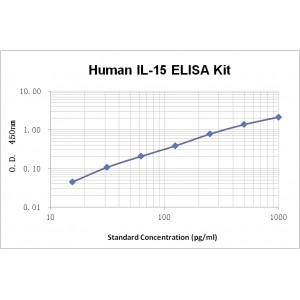
Description
|
Assay Range |
15.6–1000 pg/mL |
|
Sensitivity |
3.0 pg/mL |
|
Specificity |
No cross-reaction with other related substances detected |
|
Size |
96T |
|
Storage |
Store at 2 – 8ºC. Keep reconstituted standard and detection Ab at -20 ºC |
|
Assay Principle |
Sandwich ELISA |
|
Sample Volume |
100 µL final volume, dilution factor varies on samples |
|
Sample Type |
serum, plasma or cell culture supernatant |
|
Detection Method |
Chromogenic |
Kit Components
1. Recombinant Human IL-15 standard: 2 vials
2. One 96-well plate coated with Human IL-15 Ab
3. Sample diluent buffer: 12 mL – 1
4. Detection antibody: 130 µL, dilution 1:100
5. Streptavidin-HRP: 130 µL, dilution 1:100
6. Antibody diluent buffer: 12 mL x1
7. Streptavidin-HRP diluent buffer: 12 mL x1
8. TMB developing agent: 10 mL x1
9. Stop solution: 10 mL x1
10. Washing solution (20x): 25 mL x1
Background
IL -15 is a glycoprotein encoded by IL-15 gene in human. Human IL-15 is synthesized as a 162 amino acid (aa) precursor protein composed of a 48 aa signal peptide and a 114 aa mature fragment. In humans, an alternatively spliced form has also been identified. Human IL-15 shares approximately 73% aa sequence identity with mouse IL-15 and is active on mouse cells. The IL-15 receptor complex consists of three molecules: an IL-15 specific α-chain, a β-chain and γ-chain that is shared by the receptor complex for IL-2. The α-chain is a 237 aa protein and binds IL-15 with high affinity. It shows 54% aa sequence identity with mouse IL-15 Rα. Although the IL-15 receptor is composed of 3 chains, only the βγ dimer is required for IL-15 signaling. IL-15 plays various roles in immunoregulation. It stimulates the growth of natural killer cells, activated peripheral blood T lymphocytes, tumor infiltrating lymphocytes (TILs), and B cells. In addition, IL-15 also is a chemoattractant for human blood T lymphocytes and to induce both lymphokine-activated killer (LAK) activity in NK cells and the generation of cytolytic effector cells.