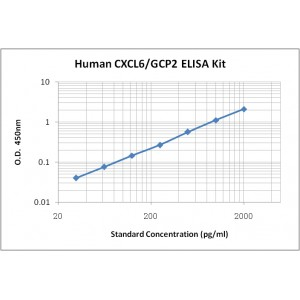
Description
|
Assay Range |
31.2–2,000 pg/mL |
|
Sensitivity |
10.0 pg/mL |
|
Size |
96T |
|
Storage |
Store at 2 – 8ºC. Keep reconstituted standard and detection Ab at -20 ºC |
|
Assay Principle |
Sandwich ELISA |
|
Sample volume |
100 µL final volume, dilution factor varies on samples. |
|
Detection Method |
Chromogenic |
Kit Components
1. Recombinant human CXCL6 standard: 2 vials.
2. One 96-well plate precoated with anti-human CXCL6 Ab
3. Sample diluent buffer: 12 mL – 1
4. Detection antibody: 130 µL, dilution 1:100.
5. Streptavidin-HRP: 130 µL, dilution 1:100
6. Antibody diluent buffer: 12 mL x1
7. Streptavidin-HRP diluent buffer: 12 mL x1
8. TMB developing agent: 10 mL x1
9. Stop solution: 10 mL x1.
10. Washing solution (20x): 25 mL x1.
Background
Chemokine (C-X-C motif) ligand 6 (CXCL6), also known as Chemokine alpha 3 (CKA-3), granulocyte chemotactic protein 2 (GCP-2), or small-inducible cytokine B6, is a small cytokine belonging to the CXC chemokine family. Human CXCL6 shares 60% sequence identity with mouse CXCL6. Three N-terminally truncated isoforms of human CXCL6 have been isolated, and show no significant variation in activity from the mature protein, while N-terminally truncated forms of mouse CXCL6 are more active than the mature form, and are more active than human CXCL6. CXC chemokine receptor 1 (CXCR1) and CXCR2, expressed on neutrophils, but not on T- or B-lymphocytes, are the receptors for CXCL6 binding and activation. CXCL6 promotes neutrophil migration and activation both in vitro and in vivo. CXCL6 may contribute to sepsis-associated tissue damage, hypersensitivity reactions, autoimmune conditions, and tumor invasion.