Description
Overview
Long Name |
Antibody Type |
Antibody Isotype |
Host |
Species Reactivity |
Validated Applications |
Purification |
| cyclin-dependent kinase 4 | Polyclonal | IgG | Rabbit | Human, Mouse, Rat | WB | Immunogen affinity purified. |
Immunogen |
||||||
| A synthetic peptide corresponding to a sequence at the C-terminus of mouse Cdk4(283-303aa RISAFRALQHSYLHKEESDAE), different from the related rat sequence by one amino acid, and from the related human sequence by four amino acids. | ||||||
Properties
Form |
Lyophilized |
Size |
100 µg/vial |
Contents |
Antibody is lyophilized with 5 mg BSA, 0.9 mg NaCl, 0.2 mg Na2HPO4, 0.05 mg Thimerosal and 0.05 mg NaN3. *carrier free antibody available upon request. |
Concentration |
Reconstitute with 0.2 mL sterile dH2O (500 µg/ml final concentration). |
Storage |
At -20 °C for 12 months, as supplied. Store reconstituted antibody at 2-8 °C for one month. For long-term storage, aliquot and store at -20 °C. Avoid repeated freezing and thawing. |
Additional Information Regarding the Antigen
Gene |
CDK4 |
Protein |
Cyclin-dependent kinase 4 |
Uniprot ID |
P30285 |
Function |
Ser/Thr-kinase component of cyclin D-CDK4 (DC) complexes that phosphorylate and inhibit members of the retinoblastoma (RB) protein family including RB1 and regulate the cell-cycle during G(1)/S transition. Phosphorylation of RB1 allows dissociation of the transcription factor E2F from the RB/E2F complexes and the subsequent transcription of E2F target genes which are responsible for the progression through the G(1) phase. Hypophosphorylates RB1 in early G(1) phase. Cyclin D-CDK4 complexes are major integrators of various mitogenenic and antimitogenic signals. Also phosphorylates SMAD3 in a cell-cycle-dependent manner and represses its transcriptional activity. Component of the ternary complex, cyclin D/CDK4/CDKN1B, required for nuclear translocation and activity of the cyclin D-CDK4 complex (By similarity). |
Tissue Specificity |
|
Sub-cellular localization |
Cytoplasm . Nucleus . Membrane . Note: Cytoplasmic when non- complexed. Forms a cyclin D-CDK4 complex in the cytoplasm as cells progress through G(1) phase. The complex accumulates on the nuclear membrane and enters the nucleus on transition from G(1) to S phase. Also present in nucleoli and heterochromatin lumps. Colocalizes with RB1 after release into the nucleus (By similarity). |
Sequence Similarities |
Belongs to the protein kinase superfamily. CMGC Ser/Thr protein kinase family. CDC2/CDKX subfamily. |
Aliases |
Cdk 4 antibody|Cdk-4 antibody|cdk4 antibody|CDK4 protein antibody|CDK4_HUMAN antibody|Cell division kinase 4 antibody|Cell division protein kinase 4 antibody|CMM 3 antibody|CMM3 antibody|Crk3 antibody|Cyclin dependent kinase 4 antibody|Cyclin-dependent kinase 4 antibody|Melanoma cutaneous malignant 3 antibody|MGC14458 antibody|p34 cdk4 antibody|PSK J3 antibody|PSK-J3 antibody |
Application Details
| Application | Concentration* | Species | Validated Using** |
| Western blot | 0.1-0.5μg/ml | Human, Rat Mouse | AssaySolutio’s ECL kit |
AssaySolution recommends Rabbit Chemiluminescent WB Detection Kit (AKIT001B) for Western blot. *Blocking peptide can be purchased at $65. Contact us for more information

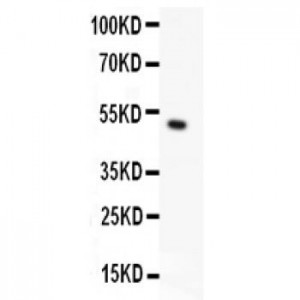
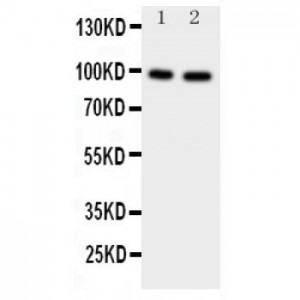
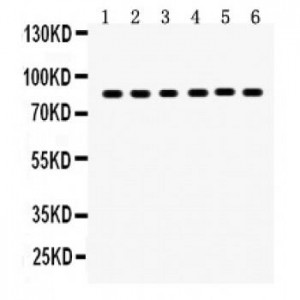
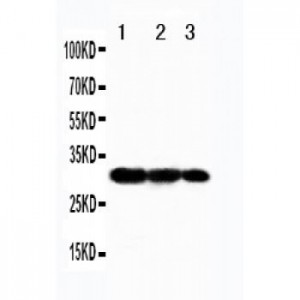
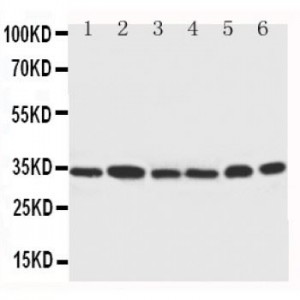
Anti-Cdk4 antibody, ASA-B0432, Western blotting
Lane 1: Rat Thymus Tissue Lysate
Lane 2: HELA Cell Lysate
Lane 3: MCF-7 Cell Lysate
Lane 4: A549 Cell Lysate
Lane 5: COLO320 Cell Lysate
Lane 6: JURKAT Cell Lysate
Lane 1: Rat Thymus Tissue Lysate
Lane 2: HELA Cell Lysate
Lane 3: MCF-7 Cell Lysate
Lane 4: A549 Cell Lysate
Lane 5: COLO320 Cell Lysate
Lane 6: JURKAT Cell Lysate