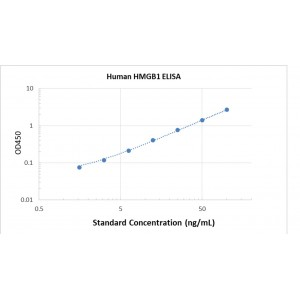
Description
|
Assay Range |
15.6-1,000 pg/mL |
|
Sensitivity |
10.0 pg/mL |
|
Size |
96T |
|
Storage |
Store at 2 – 8ºC. Keep reconstituted standard and detection Ab at -20 ºC |
|
Assay Principle |
Sandwich ELISA |
|
Sample Volume |
100 µL final volume, dilution factor varies on samples |
|
Detection Method |
Chromogenic |
Kit Components
1. Recombinant Human HBEGF: 2 vials
2. One 96-well plate coated with anti-Human HBEGF Ab
3. Sample diluent buffer: 12 mL – 1
4. Detection antibody: 130 µL, dilution 1:100
5. Streptavidin-HRP: 130 µL, dilution 1:100
6. Antibody diluent buffer: 12 mL x1
7. Streptavidin-HRP diluent buffer: 12 mL x1
8. TMB developing agent: 10 mL x1
9. Stop solution: 10 mL x1.
10. Washing solution (20x): 25 mL x1.
Background
Human HBEGF (Heparin Binding EGF-like growth factor), also known as Diphtheria toxin receptor (DT-R), is a member of the EGF family. HBEGF is synthesized as a 208 amino acid (aa) type I transmembrane preproprecursor composed of a 19 aa signal sequence, a 43 aa prosegment, an 86 aa mature region, an 11 aa juxtamembrane cleavage peptide, a 24 aa transmembrane segment, and a 25 aa cytoplasmic tail. Mature HBEGF is a soluble peptide derived from proteolytic processing of the membrane-bound form which contains an EGF-like domain and a heparin-binding motif. A series of cleaved isoforms of HBEGF and the corresponding proteases such as TACE, MMP-3, MMP- 7, ADAM-12 and ADAM-17 have been identified. HBEGF is expressed in various cell types including bronchial epithelium, visceral and vascular smooth muscle, CD4+ T cells, cardiac muscle, glomerular podocytes, keratinocytes and IL-10 secreting regulatory macrophages. HBEGF functions as a ligand for EGFR, ErbB-4, and ErbB-2. It is reported that HBEGF is required for normal cardiac valve formation and normal heart function. It is a potent mitogen for smooth muscle cells and plays a role in promoting smooth muscle cell proliferation.