Description
Reference Values
Reference values have not been established for patients who are <18 years of age.
Adult male: 22-87 mcg/L or ng/ml
Adult female premenopausal: 19-83 mcg/L or ng/ml
Adult female postmenopausal: 16-96 mcg/L or ng/ml
Citations:
1.Haakonssen EC, Ross ML, Knight EJ, Cato LE, Nana A, Wluka AE, et al. (2015) The Effects of a Calcium-Rich Pre-Exercise Meal on Biomarkers of Calcium Homeostasis in Competitive Female Cyclists: A Randomised Crossover Trial.
PLoS ONE 10(5): e0123302.
https://doi.org/10.1371/journal.pone.0123302
2.Gregory Shaw, Ann Lee-Barthel, Megan LR Ross, Bing Wang, Keith Baar, Vitamin C–enriched gelatin supplementation before intermittent activity augments collagen synthesis,
The American Journal of Clinical Nutrition, Volume 105, Issue 1, January 2017, Pages 136–143.
https://doi.org/10.3945/ajcn.116.138594
3.Effects of Different Vitamin-C Enriched Collagen Derivatives on Collagen Synthesis
Authors: Dana M. Lis , Keith Baar , Human Kinetics Journals
https://journals.humankinetics.com/doi/abs/10.1123/ijsnem.2018-0385
Related Products:
Human Pro-Collagen I alpha 1 ELISA Kit, PINP ELISA Kit, PIIINP ELISA Kit Human Pro-Collagen I alpha II ELISA kit Human Arresten/Collagen IV C-Cterminal domain ELISA
Data Sheet
| Alternate Names | P1NP; N-Propeptide Of Type I Procollagen; Procollagen I Amino Terminal Propeptide |
| Assay principle | Sandwich ELISA |
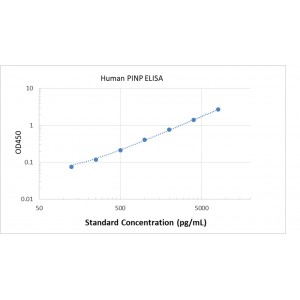
| Assay Range | 125 – 8000 pg/mL |
| Assay time | 4.5 hours |
| Background | Procollagen type I propeptides are derived from collagen type I, which is the most common collagen type found in mineralized bone. In bone, collagen is synthesized by osteoblasts in the form of procollagen. This precursor contains a short signal sequence and terminal extension peptides: amino-terminal propeptide (PINP) and carboxy-terminal propeptide. These propeptide extensions are removed by specific proteinases before the collagen molecules form. Both propeptides can be found in the circulation and their concentration reflects the synthesis rate of collagen type I. Although collagen type I propeptides may also arise from other tissues (such as the skin, vessels, fibrocartilage, and tendons), most nonskeletal tissues exhibit a slower turnover than bone, and contribute very little to the circulating pool of PINP. PINP is considered the most sensitive marker of bone formation and it is particularly useful for monitoring bone formation therapies and antiresorptive therapies; it is recommended that the test be performed at baseline before starting osteoporosis therapy and again 3 to 6 months later. PINP could be detected in the circulation as the “intact” or trimeric molecule and the monomer. In osteoporosis subjects with normal renal function, the predominant form of PINP detected in circulation is the trimeric form. However, monomeric PINP fragments may accumulate in patients with renal failure or metastatic bone disease. |
| Bulk order pricing | Contact sales@novateinbio.com |
| Country of origin | The U.S. |
| Dilution & Recommended Usage | Sample Dilution: 1:5 – 1:20 is recommended. The user may need to determine the dilution factor in a preliminary experiment. If required, samples should be diluted in sample diluent buffer. |
| Distributor | Worldwide |
| Product Citations | Available now |
| Sample type | Plasma, Serum, cell culture medlium, tissue lysate |
| Satisfaction | 100% |
| Specificty | This kit recognizes both natural and recombinant Human PINP. |
| Storage | 2 – 8 ℃ |
| Tech support | 24/7 |