Protocols

Protocol: FISH or gene tracking in vitro with labeled dCas9, dCas9-GFP, dCas9-biotin

CASFISH (Deng et al. PNAS | September 22, 2015 | vol. 112 | no. 38 | 11875)

  1. 1.     1.Cells cultured on 35-mm MatTek dishes or tissue sections were fixed at −20 °C for 20 min in a prechilled solution of methanol and acetic acid at a 1:1 ratio.
  • 2.    2. Samples were washed three times (5 min each washing) with PBS with gentle shaking, followed by incubation for 15 min at 37 °C in Blocking/Reaction Buffer [20 mM Hepes (pH 7.5), 100 mM KCl, 5 mM MgCl2, freshly added 1 mM DTT, 5% (vol/vol) glycerol, 1% BSA, and 0.1% TWEEN-20].
  • 3.   3. To assemble CASFISH probes, fluorescently labeled dCas9 protein (5–25 nM) was mixed with labeled or unlabeled sgRNA at molar ratio of 1:1 or 1:4, respectively, in blocking/reaction buffer and was incubated at room temperature for 10 min and stored on ice before the next step.
  • 4.     4. 5 nM to 25 nM of fluorescent dCas9 protein or variant was used for CASFISH against target DNA elements.
  • 5.    5. The assembled dCas9/ sgRNA was applied on preblocked cells and incubated for 5–30 min at 37 °C.
  • 6.   6. he reaction was terminated by the removal of the dCas9/sgRNA solution and washing three times with blocking/reaction buffer.

Optional: CASFISH samples can be washed further to reduce background in buffer containing 20 mM Hepes (pH 7.5), 300 mM NaCl, 3 M urea, and 1.1% (vol/vol) Nonidet P-40. 

This protocol can also be used with Cas9-GFP protein.

Protocols

Protocol: Preparation of Cas9 RNP (ribonucleoprotein), transfection into adherent cells using the Lipofectamine

Overview:

Cas9 nuclease and its variants should be used in vitro and in vivo to create RNPs. There are several ways in which to introduce Cas9-guide RNA complexes into cells. Here we present a method for the transfection of Cas9 RNP’s into HEK293T cells using Thermo Fisher Lipofectamine® RNAiMAX. This is one of the methods that use a final concentration of 10 nM RNP per transfection in a 96-well culture plate.

Materials required:

Cell Culture and Transfection

1) HEK293 cells (or other adherent cell line) at 70-90% confluency in a T-75 flask

2) Cas9 Nuclease with NLS, S. pyogenes

3) sgRNA containing the targeting sequence in the region of interest

· sgRNAs can be generated using the sgRNA Synthesis Kit, S. pyogenes of NEB

· sgRNAs must contain the target sequences (20 nucleotides) adjacent to the Protospacer Adjacent Motif (PAM, NGG) in the target DNA

4) Lipofectamine RNAiMAX Transfection Reagent (ThermoFisher)

5) Sterile 1X PBS without Ca2+ and Mg2+

6) Appropriate growth medium with FBS

7) Opti-MEM Reduced Serum Medium (ThermoFisher)

8) 96-well culture plate

Attention:

Strongly recommend wearing gloves and using nuclease-free tubes and reagents to avoid RNase contamination.

Transfection conditions may be highly variable.  It is recommended to optimize your conditions for each cell type and Cas9 target you may have. This protocol follows conditions that have been optimized for a particular target and use of HEK293 cells

Protocol:

RNP Complex Formation

1.  1. Make a 3 µM working solution of sgRNA by diluting the stock with nuclease-free water.

2.   2. Make a 3 µM working solution of Cas9-NLS by diluting with 1X Cas9 Reaction Buffer or Opti-MEM. 

3.    3. Form the RNP complexes as follows below:

   4. Gently mix the reaction and incubate at room temperature for 10 minutes. 

2.   5. Form the liposome complexes as follows below.  You can make a master mix of the RNAiMAX and Opti-MEM and add this directly to the RNP tube from above.

    6.Gently mix the reaction and incubate at room temperature for 20 minutes.

Trypsinize and Prepare HEK293 Cells

1.     1.Seed the cells so that they will be around 70-90% confluent on the day of transfection.

2.     2. During the RNP/liposome incubation, trypsinize the cells, washing once to remove any traces of trypsin. Resuspend the cells in 10 ml of media and count.

3.   3. Calculate the dilution and volume needed to get the cells to 3.2 x 10⁵ cells per ml.  You will need 125 µl of cells per well.

Transfect Cells with Liposome Complexes

1.     1. From each tube of RNP/liposome complex, aliquot 30 µl into 3 wells (10 µl/well ) of a 96-well plate.

2.  2. Add 125 µl of cells (3.2 x 10⁵ cells/ml) to each well containing RNP/liposome complex and pipette up and down gently a few times.

3.   3. Incubate the cells in a humidified 37°C, 5% CO2 incubator for 48-72 hours.

Harvest DNA and Amplify Target Region

1.  1. Gently aspirate the media from the cells and wash twice with 100 μl 1X PBS. 

2. 2. Add 75 µl of Epicentre QuickExtract DNA Extraction Solution and shake/vortex for 5 minutes. Transfer the solution to a PCR plate or tubes and place in a thermocycler, running the following program:

65°C for 15 min
95°C for 15 min
Hold at 4°C

3.  3. Dilute the DNA 1:10 in nuclease-free water.

4. 4. Follow the protocol detailed in NEB’s EnGen Mutation Detection Kit (E3321) manual.

Protocols

Dot Blot

The following protocol is a simplified alternative method , the Dot Blot, to traditional Western blotting for the detection of the presence or absence of a particular protein or bio-molecule in samples. Dot Blot differs from Westerns in that proteins in the samples are not resolved by size prior to blotting. This method is better suited for comparin g relative abundance of a target protein in a number of samples in parallel ( low-, medium-, high-throughput ).

Procedures

  • 1.Label the nitrocellulose blotting membrane for th e ease to locate your individual sample after blotting. For example, for 96-well sample dot bl ots, designate one corner of the membrane as well number A1, another corner as H12. Use indelible marker that will not bleed during processing.
  • 2.Place the labeled membrane on a filter paper. Se cure the edges of the membrane with tape or a weight to prevent the edge curling.
  • 3.Pipette 0.5-2.0uL of each sample onto separate pre-determined locations on the blot. A multi- channel pipette/96 or 384-pin head may be used to spot multiple samples at once. The samples should be absorbed to the membrane immediately without any beading on the surface.
  • 4.Block the membrane in 5% milk, 1x TBST fo r 30 minutes to 1hr on a rotating shaker.
  • 5.While blocking, dilute the primary antibody in 5% milk, 1x TBST. Prepare enough diluted antibody to cover the blot during shaking incubation.
  • 6.Decant blocking solution, rinse the membrane with 1x TBST, wash the membrane 2 – 3 times with 1x TBST buffer, each time 5 – 8 minutes with shaking on a rotating shaker.
  • 7.Incubate the membrane with the diluted primary antibody for 30 minutes to 1hr on a rotating shaker.
  • 8.If no secondary antibody or additional probes are necessary, proceed directly to step 10. Otherwise, discard the diluted primary antibody an d wash with 5% milk, 1x TBST for 5 – 8 mins on a rotating shaker. Repeat this wash step 2 additional times for a total of 3 washes.
  • 9.While washing, dilute the secondary antibody in 5% milk, 1x TBST. Prepare enough diluted antibody to cover the blot during shaking incubation.
  • 10.After washing, incubate the membrane with the diluted secondary antibody. Incubate for 30 minutes to 1hr on a rotating shaker.
  • 11.Discard the diluted primary/secondary antibody and wash with 1x TBST for 3 times, each time 5 – 8 minutes on a rotating shaker.
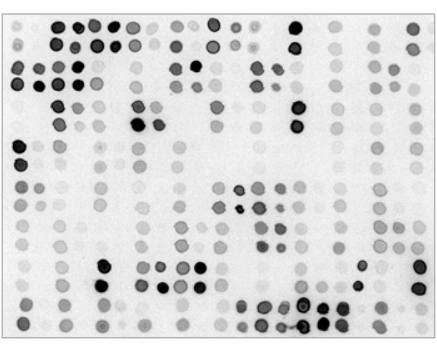
  • 12. Proceed with the appropriate ECL substrate incubation and chemiluminescence/fluorescence detection as specified by the reagents manufacturer. A sample Dot-Blot (spotted by 384- pin head ), with 0.5 ul/spot:

Reagents & Buffer

1x TBST Buffer (1L

100mL 10x Tris-Buffered Saline (500mM Tris pH 7.4, 1.5M NaCl)

10mL 10% Tween 20

890mL Deionized Water

1x TBST Buffer + 5% Milk (1L)Note: Powdered non-fat dry milk must be thoroughly dissolved into buffer before Tween-20 addition so that no sediment remains.

100mL 10x Tris-Buffered Saline (500mM Tris pH 7.4, 1.5M NaCl)

10mL 10% Tween 20

50g Blotting Grade Non-fat Dry Milk

890mL Deionized Water

Protocols

Western Blot

The following protocol is an outline of a traditio nal Western blotting protoc ol for the detection and characterization of a particular protein or bio-molecu le in a sample. Protein sample mixtures are first resolved by size using sodium dodecyl sulfate po lyacrylamide gel electrophoresis (SDS-PAGE). Then electro-transfer, or blotting of samples on the gel to a nitrocellulose or polyvinylidene fluoride (PVDF) membrane is performed. Specific proteins are then detected on the blot by a series of blocking, incubating and washing steps with the appropriate buffers and antibody probes. Wester n blots resolve complex populations of proteins and provide data on the molecular weight and abundance of a particular protein of interest in a sample mixture.

Important NOTES:

  • A single-page quick protocol is included at th e end of this document. Print this page for quick bench-top reference.
  • Protein sample preparation methods vary widely in order to deliver protein in the conformation required for a particular assay. In this protocol, denaturing and reducing conditions are used as they are most common ly applied to Western blotting procedures and typically provide for the highest sensitivity and best resolution. However, users can make changes to the sample preparation and PAGE procedures in order to run non-denaturing or non-reducing conditions. Non-reducing conditio ns require no change to the protocol apart from the exclusion of reducing reagents from preparative buffers. Non-denaturing conditions require a more dramatic change in the PAGE protocol, and is not elucidated here.
  • Western blot probes vary widely. Antibodi es can be selected with a wide range of specificities and reactivities to a protein of in terest. This protocol details the generic methodology utilizing a primary antibody for protein recognition followed by a secondary antibody. The secondary antibody, which is against the primary, and conjugated to a chemiluminescence signal amplification enzyme, Horseradish Peroxidase (HRP) for visualization. Alternative probes may have othe r blotting requirements not included in this protocol. If so, consult with the manufacturer ’s guidelines of the reagent in question for further instructions.

Procedures

  • 1.Prepare 2x LDS Buffer with 2x DTT: Reagent Volume per Sample (μL) Sample Number Preparative Volume (μL) 4x LDS Sample Buffe 10 x _____ =   1M DTT 4 x _____ =   Deionized Water 6 x _____ =  
  • 2.Prepare protein samples for loading. Add 15uL of protein sample (diluted in deionized water if necessary) to 15uL of 2x LDS buffer containing 2x DTT.
  • 3. Boil samples at 100 o C for 5 minutes.
  • 4. Set up the PAGE gel. Quickly rinse the gel with deionized water, remove the comb and rinse the wells with running buffer, place it in the electrophoresis chamber, fill the upper trough with 1x running buffer.
  • 5. Load 15uL of each prepared sample into a well on the gel in an established order.
  • 6. Run the gel at a constant 180V for approximate ly 45-60 minutes or watch the position loading dye to stop the run.
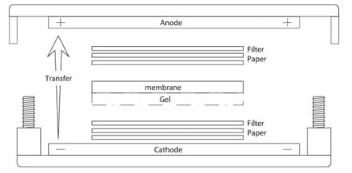
  • 7. Setup blotting sandwich and apparatus. Crack open the gel casing to access the gel. Cut away the wells and thick bottom portion of the gel. In a tray filled with 1x transfer buffer, assemble the blotting sandwich in the following order: (bottom) – filter-paper – gel – nitrocellulose – filter- paper – (top) . Place the blotting sandwich on the electroblotting apparatus as follows:
  • 8. Block the membrane in 5% milk, 1x TBST fo r 30 minutes to 1hr on a rotating shaker.
  • 9. While blocking, dilute the primary antibody in 5% milk, 1x TBST. Prepare enough diluted antibody to cover the blot during shaking incubation.
  • 10. Decant blocking solution, rinse the membrane with 1x TBST, wash the membrane 2 – 3 times with 1x TBST buffer, each time 5 – 8 minutes with shaking on a rotating shaker.
  • 11. Incubate the membrane with the diluted primary antibody for 30 minutes to 1hr on a rotating shaker.
  • 12. If no secondary antibody or additional probes are necessary, proceed directly to step 10. Otherwise, discard the diluted primary antibody an d wash with 5% milk, 1x TBST for 5 – 8 mins on a rotating shaker. Repeat this wash step 2 additional times for a total of 3 washes.
  • 13. While washing, dilute the secondary antibody in 5% milk, 1x TBST. Prepare enough diluted antibody to cover the blot during shaking incubation.
  • 14. After washing, incubate the membrane with the diluted secondary antibody. Incubate for 30 minutes to 1hr on a rotating shaker.
  • 15. Discard the diluted primary/secondary antibody and wash with 1x TBST for 3 times, each time 5 – 8 minutes on a rotating shaker.
  • 16. Proceed with the appropriate ECL substrate incubation and chemiluminescence/fluorescence detection as specified by the reagents manufacturer.

Reagents & Buffer

1x SDS-PAGE Running Buffer (1L)Note: This buffer can be re-used multiple times. Replace buffer if its color changes or if gel-running is abnormal.

50mL 20x NuPAGE MOPS SDS Running Buffer

950mL Deionized Water

1x Western Transfer Buffer (1L)Note: This buffer can be re-used multiple times. Replace buffer if its color changes or if gel transfer is abnormal.

50mL 20x NuPAGE Transfer Buffer

200mL 99-100% Methanol

750mL Deionized Water

1x TBST Buffer (1L)100mL 10x Tris-Buffered Saline (500mM Tris pH 7.4, 1.5M NaCl)

10mL 10% Tween-20

890mL Deionized Water

1x TBST Buffer + 5% Milk (1L)Note: Powdered milk must be thoroughly mixed into buffer before Tween addition so that no sediment remains.

100mL 10x Tris-Buffered Saline (500mM Tris pH 7.4, 1.5M NaCl)

10mL 10% Tween-20

50g Blotting Grade Non-fat Dry Milk

890mL Deionized Water (Bring final volume to 1L)

Disposables/Reagents
PAGE Gel, 4-12%, or 4 -20 % Bis-Tris
SDS Sample Buffer (4x)
Western Blot Protein Standard
Dithiothreitol (DTT)
Beta-mercaptoethanol
MOPS or MES SDS Running Buffer (20x)
NuPAGE Transfer Buffer (20x)
Laboratory Grade Methanol
Blotting Sandwiches
Tris-Buffered Saline (10x)
Tween-20
Blotting Grade Non-fat Dry Milk
TBS Buffer
SuperSignal West Dura Extended Duration Substrate
Equipment
Gel box
Power Supply (100-120/220-240V)
Semi-dry Electroblotting System
Chemidoc Image System or X-ray film