Services

Western Blot Service  (NB-SC113)

Western Blot Analysis Service

Our experienced protein scientists provide high-quality Western blot analysis with rapid turnaround and reliable results. With thousands of gels completed and published results, our proprietary know-how and optimized reagents minimize background and maximize signal clarity.


Capabilities

  • Homogenization of cell and tissue lysates
  • Transfection/Transduction of mammalian cells
  • In-house cell lines (HEK293, CHO) and tissue banks (rat/mouse)
  • Protein concentration determination (BCA, etc.)
  • Minimum protein concentration: 1 µg/µL
  • Membrane stripping/reprobing
  • Common antibodies available (anti-actin, HRP-labeled anti-mouse/rabbit secondary)
  • Protocol optimization for specific antigens/targets

Visualization Options

  • ChemiDoc imaging
  • Ponceau S staining
  • Gel staining after transfer

Equipment

  • Bio-Rad systems
  • Semi-dry transfer apparatus
  • Up to 9 samples per run

Deliverables

  • High-resolution gel images
  • Samples returned upon request

Turnaround Time

5 business days (after sample verification)


Requirements

For Quote Request:

  • Concentration of submitted samples

For Sample Submission:

  • Primary antibodies must be provided by the researcher
  • QC data for all samples and reagents (required before submission)
  • Note: Novateinbio will verify the quality of received materials. Additional costs may apply if inaccurate QC data or low-quality samples are submitted.

For technical questions or to place an order, please contact us

Services

ELISA TESTING services (NB-SC112)

SPENDING YOUR VALUABLE TIME ON ROUTINE ASSAYS? NO TIME TO FOCUS ON YOUR CORE RESEARCH?

LET US DO YOUR ELISAs. Choose the analyte(s), send your samples, and leave it to us to do the rest.

Novatein Biosciences offers in-house testing services for protein identification and quantification. We offer a two-working-day turnaround time on results from the time we receive a sample on most tests. Same day rush is available for samples received before (10:30 am EST). Our technical reports are highly confidential. Information is only released to the requesting individual/ company or their authorized representatives.

Capabilities:
  • – Kit-based, custom designed ELISA, or kit sent by customer
  • – Sample dilution factor determination
  • – Sandwich, competitive, indirect
  • – Homogenization of cell/tissue lysates
  • – Transfection/Transduction of mammalian cells
  • – Analyze serum, plasma, cells, tissues
  • – In-house mouse/rat serum and tissues
  • – Analyze chromogenic substrates
  • – SoftMax Pro and GraphPad software
Equipment:
  • – Multiple plate washers with stacker
  • – Multiple microplate readers for 96-well and 384-well plate
  • – MultiDrop and other dispense automations.

Typical turn-around time: 5-10 business days

ELISA assay development, validation and sample processing

Customer can use our established ELISA assays or send us kits they prefer.

Note: Customer has to provide QC data of all the samples and reagents as specified by Novateinbio prior to submission. Novateinbio will verify the quality of the received materials. Customer will be responsible for any extra cost of the project resulted from inaccurate QC data and/or low quality material submitted. Sample Types: We test a wide variety of sample types and species from bioresearch. The most common samples customers send us are:

  • Serum/ plasma
  • Cell culture supernatant
  • Cell lysates
  • Tissue homogenates
  • Urine
Common Sample Species:
  • Human
  • Mouse
  • Rat
  • Primate (non-human)
  • Dog
  • Bovine
  • Cat
  • Pig
  • Rabbit

We acknowledge the trust you place in your R&D partner, that’s why we emphasize on high quality in everything we do. We’ll implement the following measures to ensure you get reliable, consistent and accurate results every time:

  • Samples are handled with care
  • The method protocols are meticulously followed to ensure reproducibility
  • All assays are run by highly experienced scientists so you can be confident in the results

*Note: Please note that samples run at several dilutions or re-running samples at different dilutions will be considered as additional samples (40 samples/plate).

RECOMMENDED SAMPLE HANDLING AND PROCESSING

Proper processing of the collected samples is critical. It is particularly important that time constraints are observed and that samples are not left at room temperature longer than necessary. Samples should be processed and frozen at -80 °C within 2 hours of collection.

Plasma

Centrifuge plasma tubes (Citrate or EDTA tubes) at room temperature. If within tube manufacture’s specifications, spin at 2200 x g (not RPM) for 15 minutes (this speed has been chosen to attempt to remove all cellular contents and platelets from samples). Observe separation of blood cells and plasma, with plasma layer on top. Draw off only the plasma layer. Take care not to disturb buffy coat when aliquoting by leaving some plasma behind and avoiding the cell layer. Aliquot into appropriately labeled tubes. Aliquot samples immediately and then place aliquoted samples in a -80 °C freezer.

Note: Plasma samples do not need to clot, and should be centrifuged immediately after collection.

Serum

Allow serum to clot for 60 minutes at room temperature prior to centrifugation. Centrifuge serum tubes. If within tube manufacture’s specifications, spin at 2200 x g (not RPM) for 15 minutes (this speed has been chosen to attempt to remove all cellular contents and platelets from samples). Observe separation of blood cells and serum, with serum layer on top. Draw off only the serum and aliquot into appropriately labeled tubes. Aliquot samples immediately and then place aliquoted samples in a -80 °C freezer.

Urine

Collect neat urine sample. Clarify the urine by centrifugation at 14,000 x g for 5 minutes, prior to freezing, and collect the clarified supernatant. Store aliquots at -80 °C.

Cell culture lysate

Collect samples using Mammalian Protein Extraction Reagent (Thermo Scientific) following manufacturer instructions. Sufficient material can usually be obtained from a cell monolayer, 80-100% confluent, in a single well of a six-well plate, harvested with 300 μL lysis buffer.

To harvest cell lysate: -Wash cells three (3) times with Dulbecco’s Phosphate Buffered Saline (DPBS) prior to lysing. Add protease inhibitor cocktail to the lysis buffer to inhibit protease activity. Add lysis buffer to the cells followed by appropriate lysis procedure. Centrifuge lysed cells at 14,000 x g for 5 minutes, and collect the supernatant (clarified lysate). Quantify total protein amount using BCA Protein Assay Kit or similar protein quantification method.

Cell conditioned media (Cell culture supernatants)

For studies with cells cultured in 1-10% fetal bovine serum, consider including proper control samples (media controls, untreated cells and/or vehicle-treated cells) depending on the scientific question to be addressed. Keep the media volume to a minimum in order to increase protein concentration, and strive to have cell density at 75% surface area or greater. Sufficient material can usually be obtained from 1 mL media removed from 80-100% confluent cell monolayer from a single well of a six-well plate. Time points of less than 24 hours may be too early to show a differential signal, consider reducing the volume of media used for these types of experiments. Clarify cell supernatant by centrifugation at 14,000 x g for 5 minutes, prior to freezing, and collect the clarified supernatant. The minimum volume required of clarified supernatant is 100 μL. Store samples in a -80 °C freezer.

Tissue or xenograft tumor homogenates

Snap freeze (at least 5 mg) excised tissue in liquid nitrogen within 5-10 minutes of excision. Pulverize frozen tissue (using a freezer mill or similar) while maintaining low temperature using liquid nitrogen or dry ice. Use T-Per tissue protein extraction agent (Thermo Scientific) per manufacturer’s recommendation. Add 200 uL extraction buffer plus protease inhibitor cocktail per 10 mg of tissue. Homogenize in tube on ice with rotary pestle for 30 seconds, until no tissue fragments are visible. Centrifuge while cold at 14,000 x g for 10 minutes. • Collect supernatant (keep on ice). • Filter through a 0.2 micron filter into a sterile tube or plate. • Quantify total protein amount using BCA Protein Assay Kit or other similar protein quantification method.

Sample size requirements depends on the analyte to be assayed.

Please contact us to place the order.

Services

Antibody Conjugation Services  (NB-SC111)

Scientists at Novatein Biosciences are experts in antibody conjugation. You supply us the antibody and we conjugate with any molecule you want:

  • HRP
  • Biotin
  • FITC

In addition, we will validate the antibody conjugate using ELISA or western blot.

Turnaround: Less than a week

Services

Antibody Sequencing/ Recombinant Antibody Production (NB-SC110)

Novatein Biosciences provides comprehensive monoclonal antibody cloning and antibody sequencing service: The antibody (IgG, IgM, IgA, or IgE) variable regions of the heavy chain (VH) and the light chain (VL) from mouse, rat, hamster, rabbit, monkey, or human hybridomas or clonal B cells are PCR amplified and sequenced. To be 100% sure about the results of PCR-based hybridoma antibody cloning and antibody sequencing, antigen-antibody binding is confirmed by transiently expressing recombinant single-chain antibodies (scFv) or whole IgGs in HEK 293 or CHO cells, and testing whether the recombinant scFv or whole IgG retains the antigen binding affinity and specificity.

100000 cells per hybridoma are sufficient for cloning and sequencing of antibody genes.

General procedure:

1) RNA extraction from hybridoma or clonal B cells;

2) cDNA synthesis

3) 5’ RACE amplification using constant regions of VH and VL

4) Cloning of PCR fragments

5) Sequencing

7) CDR analysis

Turnaround: 2-3 weeks

Services

Generation of Stable Cell Lines Expressing Antibodies (NB-SC109)

Novatein Biosciences’ scientists are highly experienced in antibody and cell line development services. We have >95% success rate of stable cell line generation. Stable cell lines (CHO/ HEK293) are generated using our proprietary mammalian expression vector system with multiple selectable markers to simultaneously express two individual genes of interest. After transfection into mammalian cells, the clones are screened for the expression of protein of interest. The standard method for screening clones is ELISA. Additional fee will be charged for Western blot or cell-based assay of your interest. Our fast and predictive screening techniques significantly increase the speed of stable cell line development while maintaining quality and uniformity.

Following will be performed as part of this service:

  • Selection of clones
  • Detailed characterization of the top clone in a small-scale production system (viability, cell growth, and titer measurements)
  • Banking of 10-15 vials of the top clone (upto 10 million cells per vial)

Turnaround: 7-8 weeks.

Services

Ultrasensitive ELISA/ ImmunoPCR (NB-SC108)

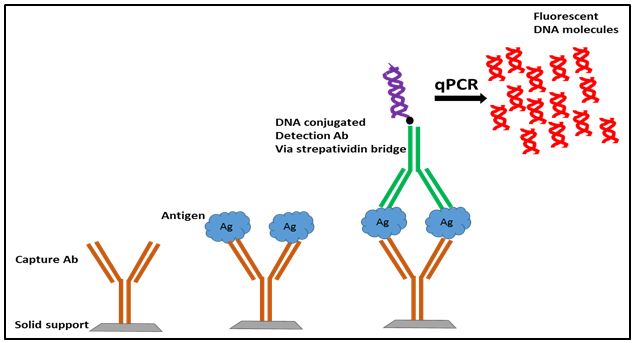
Immuno-PCR (iPCR) is a powerful method for detecting ultra-low quantities of antigens. It combines the advantages of both enzyme-linked immunosorbent assay (ELISA) and PCR in specificity, sensitivity and easy to adapt. Despite its potential, iPCR is an underutilized method as evidenced by the low number of publications on its routine application and unavailability of validated, ready-to-use commercial kits. To make it possible for the researchers to detect various low-abundant analytes, Novatein Biosciences is introducing validated and ready-to-use iPCR conversion kit and iPCR kits.  

Schematic of iPCR technique

Fig. 1. Schematic of iPCR technique

Novatein Bioscience’s iPCR conversion kit makes it possible to convert moderately sensitive conventional ELISA to an ultra-sensitive iPCR.  The kit has all the reagents except antibodies and standard. One of the main advantages of using Novatein Bioscience’s iPCR conversion kit is its scalability to high-throughput systems. In a typical work day, ~500 samples can be quantified in triplicate.

Other advantages of iPCR over conventional ELISA include:

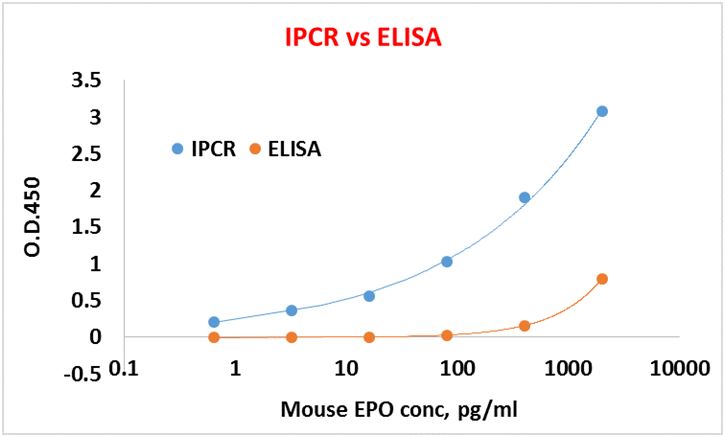
  • 10-100 fold improvement in the assay range making it possible to quantify low-abundant targets like HMGB1, HCP etc
  • Low amounts of sample is needed, which means saving of precious samples and no matrix effect.

In addition, Novatein Bioscience is offering the following validated iPCR kits:

  • Mouse Erythropoietin iPCR kit
  • Host Cell Protein (HCP) iPCR Kit
  • Mouse HMGB1 iPCR Kit
  • Human HMGB1 iPCR Kit
  • Rat HMGB1 iPCR Kit

Comparison of IPCR and ELISA: Detection of Mouse Erythropoietin

IPCR vs ELISA
Services

Development of an AlphaLisa assay for Screening Histone Methyltransferase Inhibitors (NB-SC107)

A top pharmaceutical company based in US approached us to develop an AlphaLisa assay for the histone methyltransferase G9a/ EHMT2. The experimental design and results are as follows:

Assay Buffer:

Used for the enzyme reaction and diluting G9a enzyme, biotinylated histone H3 (1-21) peptide, SAM and inhibitors.

Formulation: 50 mM Tris-HCl pH 8.0, 50 mM NaCl, 1 mM DTT, 0.01% Tween-20, 0.005% BSA.

HMT Buffer 1:

Used to dilute the acceptor and donor beads.

Assay Protocol:

Dilute G9a enzyme, biotinylated histone H3 (1-21) peptide, SAM and inhibitors in assay buffer just before use.

Add the following to 384-well white plate wells:

5 μL assay buffer or inhibitor (2X)

2.5 μL of enzyme (4X)

2.5 μL of biotinylated Histone H3 (1-21) peptide/ SAM mix (4X)

Cover the plate with a sealer and incubate at RT.

Prepare H3K9me2 acceptor beads in 1X Epigenetics Buffer 1. Add 5 μL Acceptor beads to each well. Cover the plate with a sealer and incubate for 60 min at RT in dark.

Prepare streptavidin donor beads in 1X Epigenetics Buffer 1. Add 10 μL Donor beads in subdued light. Cover the plate with a sealer and incubate for 30 min at RT in dark.

Read signal in Alpha enabled readers. Novatein Biosciences used BMG Pherastar.

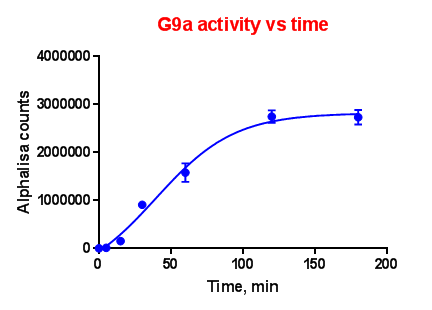
Effect of time on G9a enzyme activity:

G9a was incubated with 100 nM biotinylated Histone-H3 (1-21) peptide and 100 µM S-adenosyl methionine (SAM) for various time points. Acceptor and donor beads were used at 5 μg/ml and 20 μg/ml. As the counts obtained with 5 μg/ml were good, we used both the beads at 5 μg/ml final concentration in the assay.

Time (min)Alpha Counts (blank subtracted)
180275579228702442572242
120263054127189702885052
60168573713539781692881
30905154854907967214
1517282480978204934
514535642217062
0000
G9a Activity VS Time

For all the subsequent experiments, enzyme assay incubation was carried out for 1 hour.

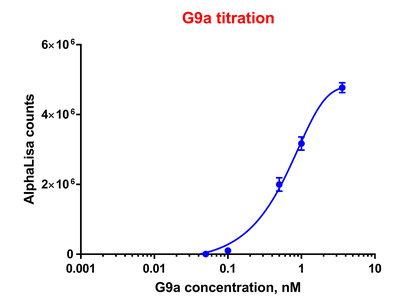
Effect of G9a concentration on enzyme activity:

G9a was incubated with biotinylated Histone-H3 (1-21) peptide and S-adenosyl methionine (SAM) for 1 hour. Acceptor and donor beads were used at 5 μg/ml. Beads alone was used as blank.

G9a (nM)Alpha counts (blank subtracted)
0.05598584173401
0.18373398553129029
0.5204966317852782162409
1299962533702963142182
3.6472499646598074927650

G9a Titration

For all the subsequent experiments, 0.5 nM G9a was used.

Effect of SAM concentration on enzyme activity:

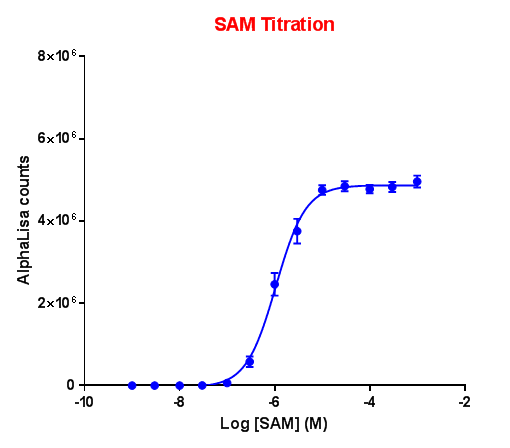
G9a was incubated with biotinylated Histone-H3 (1-21) peptide and S-adenosyl methionine (SAM) for 1 hour. Acceptor and donor beads were used at 5 μg/ml.

SAM Titration

For all the subsequent experiments, ~Km concentration of SAM was used.

Inhibitor titration:

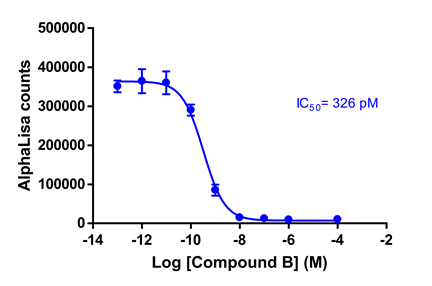
Two compounds were given to us to evaluate in this assay setting:

Compounds (100 pM – 100 µM) were pre-incubated with G9a for 15 min at RT. Biotinylated Histone H3 (1-21) peptide and SAM were added and further incubated for 1 hour at RT. Acceptor and donor beads were added at 5 μg/ml and read on BMG Pherastar. IC50 was calculated using Graphpad Prism.

Compound A (M)AlphaLisa counts
0264765244865273171
1e-010391874382441356612
1e-009363907330334335046
1e-008283283292220326192
1e-007179702140330165547
0.000001531433722144270
0.00001145351210312198
0.0001898777148645

IC50 of compound A was determined as 7.1 nM.

AlphaLisa Counts
Services

Hybridoma Sequencing (NB-SC106)

We offer reliable antibody sequencing, cloning and expression/purification services. With your hybridoma cell line pellet ( 1 x 10^7), we will sequence heavy and light chain variable regions, variable regions plus leader sequences, or full-length heavy and light chain antibodies.

Furthermore, we offer antibody production services, including cloning of heavy and light chain variable regions or full-length antibodies, co-transfection and expression, purification and validation of antigen binding by plate based assay.

  • Total RNA extraction from hybidoma or B cells.
  • cDNA synthesis from total RNA by reverse transcription.
  • 5’ RACE PCR to get DNA fragments corresponding to VH and VL.
  • Cloning into a sequencing vectors like pUC118 and sequencing.
  • Sequencing analysis ( sequence data, alignment of each chain) for at least 5-10 independent
  • clones: both VH and VL
  • Sequencing data summary report, delivery of plasmid.

Services available:

<th >Price<tr >Variable Domains Sequencing for both Light chain and Heavy chain<td >$950 <td >2 weeks<tr >Variable domains sequencing for both LV and HV, plus leader sequence. Cat# CS8-2<td >$1,200 <td >2-3 weeks<tr >Full Length sequencing for variable regions, constant domains and leader sequences<td >$1,400 <td >3 weeks

ServiceTurnaround Time
Services

AlphaLisa™ and Alphascreen™ Assays (NB-SC105)

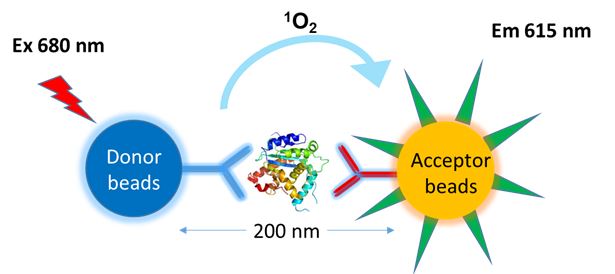
Alpha technology (Amplified Luminescent Proximity Homogeneous Assay) is a homogenous, no-wash assay method used to study biomolecular interactions in microplate format. The technology is based on Donor and Acceptor beads containing a proprietary mixture of chemicals, which, when excited emit luminescent signal. The Donor bead contains phthalocyanine which converts ambient oxygen (O2) to singlet oxygen when excited at 680 nm. As the singlet oxygen has a very short half-life (4 µsec) it is able to diffuse 200 nm in solution and transfer its energy to the thioxene derivatives within the acceptor beads resulting in luminescent signal production at 520-620 nm (AlphaScreen) or 615 nm (AlphaLISA). If there is no acceptor bead present within 200 nm in solution, singlet oxygen falls back to the ground state and no signal is produced.

Common Applications:

Biomarker/ cytokine detection: Immunoassays of secreted analytes from cell Culture or serum/ plasma

Cell signaling- To detect epigenetic/ kinase post-translational modifications

Cell-based assays- For studying pathways in whole cells, or studying endogenous receptors

To study protein—protein and protein—nucleic acid interactions ­

Second messengers: e.g., GPCR research

Ligand-Receptor Interactions Detection of Epigenetic or Post-Translational Modifications

Examples of Projects Completed at Novatein Biosciences

1. Development of an AlphaLisa assay for Screening Histone Methyltransferase Inhibitors

2. Antibody Pair Screening for TMEM153 /STING

AlphaLisa™ and Alphascreen™ are trademarks of Perkin Elmer, Inc.

Services

ELISA Assay Development (NB-SC103)

Novatein Biosciences is committed to accelerate Research and Development by providing custom solutions to researcher needs. Our custom services team is comprised of a project manager and a team of expert scientists with extensive experience in manufacturing and assay development. We will develop a custom solution only after fully understanding your needs. Our scientists and project management team will provide data reports throughout the assay development process. We have resources and capabilities to develop the following assays:

Our assay development service includes:

  • Background research- viability of the idea
  • Assay design- ELISA/ Alphalisa/ Luminex
  • Purification of recombinant & native antigens- bacterial/ yeast/ mammalian
  • Production of high affinity antibodies- species/ polyclonal/ monoclonal
  • Matched antibody pair screening- TR-FRET/ Alphalisa
  • Assay validation- Specificity, sensitivity, matrix effects and CV

Please contact us for more information. Or call us at (617) 238-1396 / (888) 856-2858