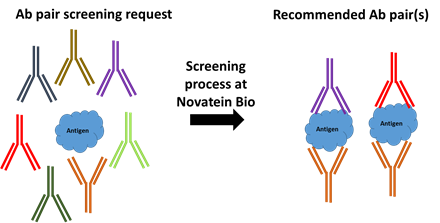
The identification of antibody pair for using in sandwich immunoassays is a tiresome and time-consuming process. As an expert in developing and validating novel immunoassays, Scientists at Novatein Biosciences use the bead-based alphascreen method to screen and select the best complementary pair for sandwich immunoassays.
The whole process of antibody pair screening is divided in to three stages:
Selection of antibodies
Sensitivity, selectivity and overall performance of an immunoassay is largely dependent on the antibody selection and hence, this is the critical step in immunoassay development. We use our in-house developed antibodies or source them from a trusted commercial manufacturer. The client also has the flexibility of using their own hybridoma supernatants/ purified antibodies.
Conjugation of antibodies to the beads
The selected antibodies are conjugated to the acceptor and donor beads at saturating concentrations. Using a matrix approach, the selected antibodies will be tested against each other. Each antibody is captured on both donor and acceptor beads and complemented with its pairing antibody in the opposite bead.
Data collection and analysis
Assay will be performed by one of our expert scientists and read on BMG Pherastar. A color-coded matrix will be generated including the alphascreen counts (see below). The client will receive a detailed technical report along with our recommendation regarding the best antibody pair.
Recent Projects:
Antibody Pair screening to detect STING/TMEM173
A total of 3 antibodies were shortlisted for the screening process. After conjugating the antibodies to the acceptor and donor beads, alphalisa assay was performed and quantified using BMG Pherastar reader. A color-coded matrix was generated as shown below:
Antibody 1D
Antibody 2D
Antibody 3D
Antibody 1A
3721
300711
57650
Antibody 2A
392195
16397
4647
Antibody 3A
61409
4098
18846
In Antibody 1A and Antibody 1D, 1 refers to the antibody# and A or D refer to conjugation to acceptor or donor beads respectively.
Using the above recommended antibody pair (Antibody 2 on acceptor beads and antibody 1 on donor beads) the assay range is determined to be 62.5 pg to 2000 pg/mL.
Generation of Stable Cell Lines Expressing Antibodies
Novatein Biosciences’ scientists are highly experienced in antibody and cell line development services. We have >95% success rate of stable cell line generation. Stable cell lines (CHO/ HEK293) are generated using our proprietary mammalian expression vector system with multiple selectable markers to simultaneously express two individual genes of interest. After transfection into mammalian cells, the clones are screened for the expression of protein of interest. The standard method for screening clones is ELISA. Additional fee will be charged for Western blot or cell-based assay of your interest. Our fast and predictive screening techniques significantly increase the speed of stable cell line development while maintaining quality and uniformity.
Following will be performed as part of this service:
Selection of clones
Detailed characterization of the top clone in a small-scale production system (viability, cell growth, and titer measurements)
Banking of 10-15 vials of the top clone (upto 10 million cells per vial)
Turnaround: 7-8 weeks.
Antibody Sequencing/ Recombinant Antibody Production
Novatein Biosciences provides comprehensive monoclonal antibody cloning and antibody sequencing service: The antibody (IgG, IgM, IgA, or IgE) variable regions of the heavy chain (VH) and the light chain (VL) from mouse, rat, hamster, rabbit, monkey, or human hybridomas or clonal B cells are PCR amplified and sequenced. To be 100% sure about the results of PCR-based hybridoma antibody cloning and antibody sequencing, antigen-antibody binding is confirmed by transiently expressing recombinant single-chain antibodies (scFv) or whole IgGs in HEK 293 or CHO cells, and testing whether the recombinant scFv or whole IgG retains the antigen binding affinity and specificity.
100000 cells per hybridoma are sufficient for cloning and sequencing of antibody genes.
General procedure:
1) RNA extraction from hybridoma or clonal B cells;
2) cDNA synthesis
3) 5’ RACE amplification using constant regions of VH and VL
4) Cloning of PCR fragments
5) Sequencing
7) CDR analysis
Turnaround: 2-3 weeks
Antibody Conjugation Services
Scientists at Novatein Biosciences are experts in antibody conjugation. You supply us the antibody and we conjugate with any molecule you want:
HRP
Biotin
FITC
In addition, we will validate the antibody conjugate using ELISA or western blot.
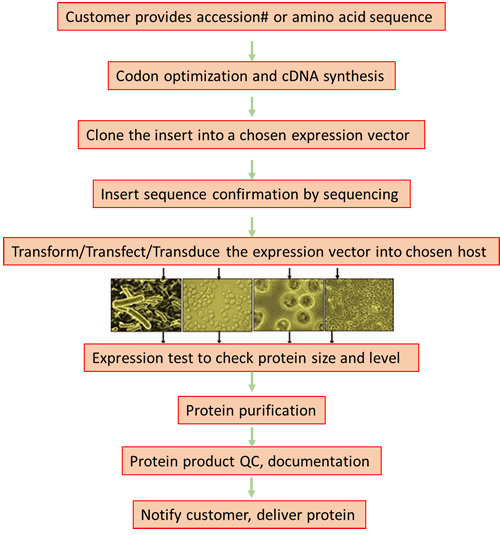
Novatein Biosciences offers recombinant protein production services to accelerate your research and development, by using highly efficient recombinant protein expression strategies. A general outline of our protein production service is as follows:
Codon optimization and cDNA synthesis: Customer provides the accession number or the amino acid sequence of the target gene. We will do free codon optimization and cDNA synthesis.
Gene cloning: The synthesized cDNA will be cloned into an expression vector ( for host of any of the bacterial/ yeast/ baculoviral or mammalian ) and the sequence is authenticated by DNA sequencing.
Gene expression: the target gene will be expressed in an optimized conditions. Expression level and integrity will be checked by SDS-PAGE and/or Western blot.
Protein Purification: The protein will be purified by column chromatography procedures (affinity and gel filtration).
Protein Identification: The purified protein will be separated on SDS-PAGE gel and stained/ transferred to membrane for immunoblot. Mass spectrometry can be performed for an additional charge.
Note: Customer can also send us their expression vector to start protein production. Or send us protein preps for further purification and characterization.
Novatein Biosciences has extensive experience in the recombinant protein expression and purification. Express your proteins with or without tags in
Mammalian cells: CHO, HEK293 and others (5 – 7 weeks)
With our over a decade years of experience, we are experts in creating and optimizing stable and transient expression for secreted or intracellular, cytosolic or periplasmic, tagged or untagged proteins. We assess expression levels using the SDS-PAGE, Western, ELISA or functional analysis. We optimize protein expression by modification of, promoter, ribosome binding site, vector copy number, host cell, growth condition including media and additives, time, and temperature In addition, we offer the following services:
Inclusion body purification
Refolding with typical or preferred protocols
For protein purification, we have the capability to run the following:
Affinity Chromatography
Ni- NTA, Talon resins, Glutathione Sepharose, Streptavidin Sepharose, and anti-Flag
Ion Exchange Chromatography
Mono-Q, Q Sepharose Fast Flow, Resource Q, Q Sepharose XL, ANX, DEAE Sepharose, SP Sepharose, CM Sepharose
Hydrophobic interaction Chromatography
Phenyl and (CH2)n Sepharose
Immuno-Affinity Chromatography
Protein A and Protein G Sepharose
Size Exclusion Chromatography
Antibody and Fc Fusion Protein Production and Purification Services (low or very low endotoxin levels)
Novatein Biosciences has extensive experience in the expression and purification of recombinant antibody and Fc fusion proteins from microgram to kilogram scales in CHO and HEK 293 cells. Using our proprietary fully optimized secretion signal and linker sequences, we can efficiently complete a project from gene construction to Fc fusion protein purification. Fc fusion can be N-terminal or C-terminal. Multiple Fc backbones are available to choose from.
Fast turnaround:
1-2 weeks for codon optimization and synthesizing the gene of interest. 1 week for molecular construction of recombinant Fc fusion proteins.
Protein A is used for recombinant antibody purification. Please request if multiple purification methods are required.
Recombinant Protein Production Using the Insect Cell Expression System
Gene of interest (GOI) is cloned into a suitable donor plasmid containing a mini-Tn7 element.
The recombinant donor plasmid is then transformed into E. coli cells which contain a bacmid with a mini-attTn7 target site and a helper plasmid. The mini-Tn7 element on the donor plasmid facilitates transposition of the GOI into the target site on the bacmid resulting in insertion of the GOI into the bacmidDNA.
Recombinant bacmid DNA is extracted and purified (for efficient homologous recombination, pure DNA is required).
Insect cells are transfected with the recombinant bacmid DNA to produce recombinant baculovirus particles with GOI (P1 virus generation)
The insect cell cultures are infected with the purified P1 stock to create a P2 stock (100 ml serum free medium).
A high quality high titer working virus stock P3 (~500 ml) is produced by infecting Sf9 cells with a P2 virus at a low multiplicity of infection (MOI=0.1)
Optimization of heterologous protein expression and purification of protein by successive chromatography techniques
Under construction— no orders shall be fulfilled. Dismiss