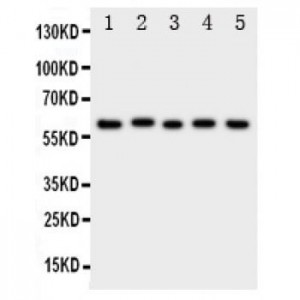
Description
Overview
Long Name |
Antibody Type |
Antibody Isotype |
Host |
Species Reactivity |
Validated Applications |
Purification |
| acid-sensing(proton-gated) ion channel 3 | Polyclonal | IgG | Rabbit | Human, Mouse, Rat | WB | Immunogen affinity purified. |
Immunogen |
||||||
| A synthetic peptide corresponding to a sequence at the N-terminus of human ASIC3 (56-73aa, FLYQVAERVRYYREFHHQ), different from the related rat and mouse sequences by two amino acids. | ||||||
Properties
Form |
Lyophilized |
Size |
100 µg/vial |
Contents |
Antibody is lyophilized with 5 mg BSA, 0.9 mg NaCl, 0.2 mg Na2HPO4, 0.05 mg Thimerosal and 0.05 mg NaN3. *carrier free antibody available upon request. |
Concentration |
Reconstitute with 0.2 mL sterile dH2O (500 µg/ml final concentration). |
Storage |
At -20 °C for 12 months, as supplied. Store reconstituted antibody at 2-8 °C for one month. For long-term storage, aliquot and store at -20 °C. Avoid repeated freezing and thawing. |
Additional Information Regarding the Antigen
Gene |
ASIC3 |
Protein |
Acid-sensing ion channel 3 |
Uniprot ID |
Q9UHC3 |
Function |
Cation channel with high affinity for sodium, which is gated by extracellular protons and inhibited by the diuretic amiloride. Generates a biphasic current with a fast inactivating and a slow sustained phase. In sensory neurons is proposed to mediate the pain induced by acidosis that occurs in ischemic, damaged or inflamed tissue. May be involved in hyperalgesia. May play a role in mechanoreception. Heteromeric channel assembly seems to modulate channel properties. |
Tissue Specificity |
Expressed by sensory neurons. Strongly expressed in brain, spinal chord, lung, lymph nodes, kidney, pituitary, heart and testis. |
Sub-cellular localization |
Cell membrane ; Multi-pass membrane protein . Cytoplasm . Note: Cell surface expression may be stabilized by interaction with LIN7B and cytoplasmic retention by interaction with DLG4. In part cytoplasmic in cochlea cells (By similarity). |
Sequence Similarities |
Belongs to the amiloride-sensitive sodium channel (TC 1.A.6) family. ASIC3 subfamily. |
Aliases |
ACCN 3 antibody|ACCN3 antibody|ACCN3_HUMAN antibody|Acid sensing ion channel 3 antibody|Acid-sensing ion channel 3 antibody|Amiloride sensitive cation channel 3 antibody|Amiloride sensitive cation channel 3 testis antibody|Amiloride-sensitive cation channel 3 antibody|ASIC 3 antibody|ASIC3 antibody|DRASIC antibody|hASIC 3 antibody|hASIC3 antibody|hTNaC 1 antibody|hTNaC1 antibody|Modulatory subunit of ASIC 2a antibody|Modulatory subunit of ASIC2a antibody|Neuronal amiloride sensitive cation channel 3 antibody|Neuronal amiloride-sensitive cation channel 3 antibody|Proton gated cation channel subunit antibody|SLNAC 1 antibody|SLNAC1 antibody|Testis sodium channel 1 antibody|TNaC 1 antibody|TNaC1 antibody |
Application Details
| Application | Concentration* | Species | Validated Using** |
| Western blot | 0.1-0.5μg/ml | Human, Mouse, Rat | AssaySolutio’s ECL kit |
AssaySolution recommends Rabbit Chemiluminescent WB Detection Kit (AKIT001B) for Western blot. *Blocking peptide can be purchased at $65. Contact us for more information

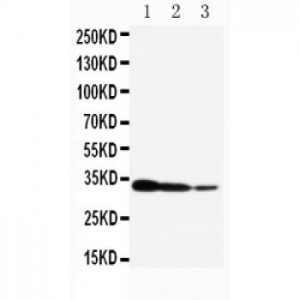
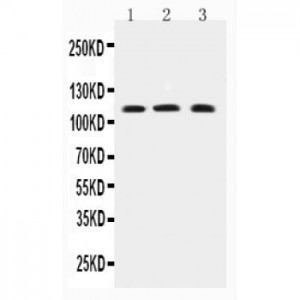
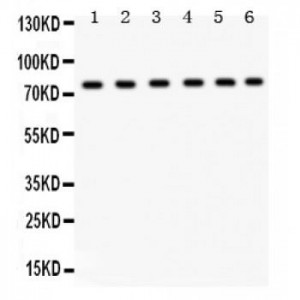
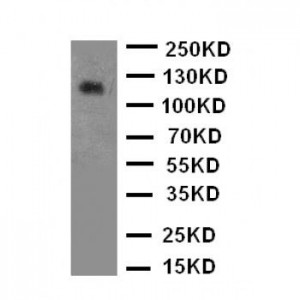
Anti-ASIC3 antibody, ASA-B0157, Western blotting
Lane 1: Rat Brain Tissue Lysate
Lane 2: Rat Testis Tissue Lysate
Lane 3: U87 Cell Lysate
Lane 4: NEURO Cell Lysate
Lane 5: SMMC Cell Lysate
Lane 1: Rat Brain Tissue Lysate
Lane 2: Rat Testis Tissue Lysate
Lane 3: U87 Cell Lysate
Lane 4: NEURO Cell Lysate
Lane 5: SMMC Cell Lysate