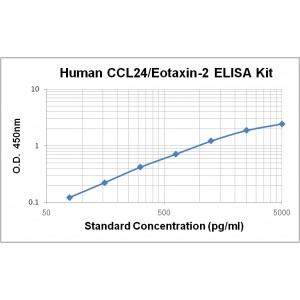
Description
|
Assay Range |
78 – 5,000 pg/mL |
|
Sensitivity |
2.0 pg/mL |
|
Size |
96T |
|
Storage |
Store at 2 – 8ºC. Keep reconstituted standard and detection Ab at -20 ºC |
|
Assay Principle |
Sandwich ELISA |
|
Sample Volume |
100 µL final volume, dilution factor varies on samples |
|
Detection Method |
Chromogenic |
Kit Components
1. Recombinant Human CCL24 standard: 2 vials
2. One 96-well plate coated with Human CCL24 Ab
3. Sample diluent buffer: 12 mL – 1
4. Detection antibody: 130 µL, dilution 1:100
5. Streptavidin-HRP: 130 µL, dilution 1:100
6. Antibody diluent buffer: 12 mL x1
7. Streptavidin-HRP diluent buffer: 12 mL x1
8. TMB developing agent: 10 mL x1
9. Stop solution: 10 mL x1
10. Washing solution (20x): 25 mL x1
Background
Eotaxin-2, also known as CCL24, MPIF-2, or Ckβ-6, is a small cytokine belonging to the CC chemokine family. Eotaxin-2 mRNA is expressed in activated T lymphocytes, GM-CSF treated macrophages, and dermal fibroblasts. Mature Eotaxin-2 is a 93 amino acid (aa) glycoprotein exhibiting relatively low aa identity with Eotaxin. Eotaxin-2 selectively recruits and activates eosinophils and basophils both in vitro and in vivo. Eotaxin-2 primarily binds to the G-protein-coupled receptor CCR3 expressed on eosinophils, basophils, subpopulations of Th2 lymphocytes, and keratinocytes to initiate a series of biological processes including actin polymerization, a transient rise in cytosolic calcium concentration, and release of reactive oxygen species. However, CCR3 is also a ligand for other chemokines such as Eotaxin, MCP-2, MCP-3, MCP-4, MIP-1δ, and RANTES. Eotaxin-2 has been implicated in certain pathological conditions linked to allergic reactions and parasitic infections.