Description
|
Assay Range |
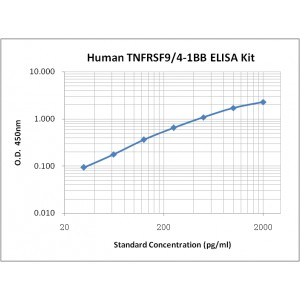
31.2-2,000 pg/mL |
|
Sensitivity |
10.0 pg/mL |
|
Specificity |
No cross-reaction with other related substances detected |
|
Size |
96T |
|
Storage |
Store at 2 – 8ºC. Keep reconstituted standard and detection Ab at -20 ºC |
|
Assay Principle |
Sandwich ELISA |
|
Sample Volume |
100 µL final volume, dilution factor varies on samples |
|
Sample Type |
serum, plasma or cell culture supernatant |
|
Detection Method |
Chromogenic |
Kit Components
1. Recombinant Human TNFRSF9 standard: 2 vials
2. One 96-well plate coated with Human TNFRSF9 Ab
3. Sample diluent buffer: 12 mL – 1
4. Detection antibody: 130 µL, dilution 1:100
5. Streptavidin-HRP: 130 µL, dilution 1:100
6. Antibody diluent buffer: 12 mL x1
7. Streptavidin-HRP diluent buffer: 12 mL x1
8. TMB developing agent: 10 mL x1
9. Stop solution: 10 mL x1
10. Washing solution (20x): 25 mL x1
Background
4-1BB, also known as CD137, T-cell antigen ILA, or tumor necrosis factor receptor superfamily member 9 (TNFRSF9), is a transmembrane glycoprotein belonging to the TNF receptor superfamily. Mature human 4-1BB consists of a 163 amino acid (aa) extracellular domain (ECD) with four TNFR cysteine-rich repeats, a 27 aa transmembrane segment, and a 42 aa cytoplasmic domain. 4-1BB is expressed as a disulfide-linked homodimer on various populations of activated T cell including CD4+, CD8+, memory CD8+, NKT, and regulatory T cells as well as on myeloid and mast cell progenitors, dendritic cells, mast cells, and bacterially infected osteoblasts. The ECD of human 4-1BB shares 60% aa sequence identity with mouse and rat 4-1BB. It binds with high affinity to the transmembrane 4-1BB Ligand/TNFSF9 expressed on antigen presenting cells and myeloid progenitor cells. 4-1BB mediated signaling costimulates the proliferation, activation, and/or survival of the 4-1BB expressing cells. It can also enhance the activation induced cell death of repetitively stimulated T cells. It is reported that mice lacking 4-1BB show augmented T cell activation. Elevated levels of soluble forms of 4-1BB have been detected in the serum of rheumatoid arthritis.