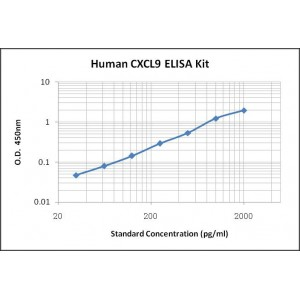
Description
|
Assay Range |
31.2-2,000 pg/mL |
|
Sensitivity |
2.0 pg/mL |
|
Specificity |
No cross-reaction with other related substances detected |
|
Size |
96T |
|
Storage |
Store at 2 – 8ºC. Keep reconstituted standard and detection Ab at -20 ºC |
|
Assay Principle |
Sandwich ELISA |
|
Sample Volume |
100 µL final volume, dilution factor varies on samples |
|
Detection Method |
Chromogenic |
Kit Components
1. Recombinant Human CXCL9 standard: 2 vials
2. One 96-well plate coated with Human CXCL9 Ab
3. Sample diluent buffer: 12 mL – 1
4. Detection antibody: 130 µL, dilution 1:100
5. Streptavidin-HRP: 130 µL, dilution 1:100
6. Antibody diluent buffer: 12 mL x1
7. Streptavidin-HRP diluent buffer: 12 mL x1
8. TMB developing agent: 10 mL x1
9. Stop solution: 10 mL x1
10. Washing solution (20x): 25 mL x1
Background
CXCL9, also known as Monokine Induced by Gamma Interferon (MIG), Gamma-interferon- induced monokine, Small-inducible cytokine B9, is a small cytokine belonging to the CXC chemokine family. CXCL9 is synthesized as a 125 amino acid (aa) precursor protein with a 22 aa signal sequence and a 103 aa mature protein. It is closely related to two other CXC chemokines CXCL10 and CXCL11 which lack an ELR (Glu-Leu-Arg) motif in front of the first cysteine. It is reported that ELR+ CXC chemokines attract neutrophils and promote angiogenesis via chemokine receptors CXCR1 and CXCR2, ELR- CXC chemokines including CXCL9 recruit activated lymphocytes and retard angiogenesis via the chemokine receptor CXCR3. Expression of MIG is induced by IFN-γ in a variety of cells and tissues, including monocytes/macrophages, neutrophils, keratinocytes, endothelial cells, epithelial cells, astrocytes, thyrocytes, liver, and kidney. IFN-γ-dependent production of CXCL9 by endothelial cells is inhibited by nitric oxide (NO) donors such as sodium nitroprusside and peroxisome proliferator-activated receptor-γ activators such as 15-deoxy-PGJ2, and lysophosphatidylcholine. These observations have been implicated in the pathogenesis of certain related diseases. In mouse models, CXCL9 is important in anti-viral host defense and can induce T cell-dependent tumor regression.