Description
Osteocalcin in vitro ELISA (Enzyme-Linked Immunosorbent Assay) kit is designed for the quantitative measurement of Osteocalcin protein in human serum, plasma and serum-free cell culture supernatants.
Contact techsupport@novateinbio.com for more details of this ELISA Kit.
For protocol and manuals, please request through email at info@novateinbio.com
Data Sheet
| Alternate Names | BGLAP, BGP, OC, OCN, bone gamma-carboxyglutamate protein, Osteocalcin |
| Assay Methods | Equilibrate all materials and prepared reagents to room temperature prior to use. It is recommended to assay all standards, controls and samples in duplicate |
| Assay principle | The Human Osteocalcin ELISA Kit is based on standard sandwich enzyme-linked immunosorbent assay technology. Anti-Human Osteocalcin specific antibody has been pre-coated onto 96-well plate. Human Osteocalcin present in the standards/ samples bind to the capture antibody. Subsequently, biotinylated anti Human Osteocalcin detection antibody is added to form an Ab Ag-Ab sandwich. After a washing step, streptavidin-HRP is added and the unbound conjugate is removed with wash buffer. Next, addition of HRP substrate, TMB, results in the production of a blue colored product that changes to yellow after the addition of acidic Stop Solution. The density of yellow color is directly proportional to the amount of Human Osteocalcin captured on plate. |
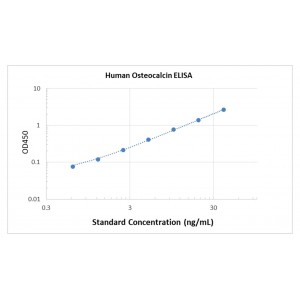
| Assay Range | 0.62 – 40 ng/mL |
| Assay Time | 4.5 hours |
| Assay Type | Sandwich ELISA |
| Background | Osteocalcin, also known as bone gamma-carboxyglutamic acid-containing protein (BGLAP), is a noncollagenous protein hormone found in bone and dentin, first identified as a calcium-binding protein in chick bone. Because it has gla domains, its synthesis is vitamin K dependent. In humans, the osteocalcin is encoded by the BGLAP gene. Its receptor is GPRC6A. Osteocalcin is secreted solely by osteoblasts and thought to play a role in the body’s metabolic regulation and is pro-osteoblastic, or bone-building, by nature. It is also implicated in bone mineralization and calcium ion homeostasis. Osteocalcin acts as a hormone in the body, causing beta cells in the pancreas to release more insulin, and at the same time directing fat cells to release the hormone adiponectin, which increases sensitivity to insulin. Osteocalcin acts on Leydig cells of the testis to stimulate testosterone biosynthesis and therefore affect male fertility. Osteocalcin also acts on myocytes to promote energy availability and utilization and in this manner favors exercise capacity. As osteocalcin is produced by osteoblasts, it is often used as a marker for the bone formation process. It has been observed that higher serum-osteocalcin levels are relatively well correlated with increases in bone mineral density (BMD) during treatment with anabolic bone formation drugs for osteoporosis, such as Teriparatide. In many studies, osteocalcin is used as a preliminary biomarker on the effectiveness of a given drug on bone formation. For instance, one study which aimed to study the effectiveness of a glycoprotein called lactoferrin on bone formation used osteocalcin as a measure of osteoblast activity. |
| Category | Bone biomarker ELISA kit |
| Dilution Factors | 1:1 or 1:2 in Sample Diluent Buffer |
| Gene ID | 632 |
| Kit Type | Colorimetric |
| Sample Type | Plasma, Serum, Cell Supernatant |
| Sample Volume | 100 uL |
| Sensitivity | 0.12 ng/mL |
| Storage | Store kit at 2-8ºC immediately upon receipt. |
| UniProt ID | P02818 |