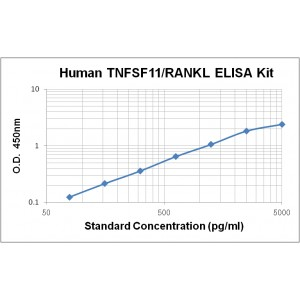
Description
|
Assay Range |
78 —- 5,000 pg/mL |
|
Sensitivity |
10.0 pg/mL |
|
Size |
96T |
|
Storage |
Store at 2 – 8ºC. Keep reconstituted standard and detection Ab at -20 ºC |
|
Assay Principle |
Sandwich ELISA |
|
Sample Volume |
100 µL final volume, dilution factor varies on samples |
|
Detection Method |
Chromogenic |
Kit Components
1. Recombinant Human TNFSF11 standard: 2 vials
2. One 96-well plate coated with Human TNFSF11 Ab
3. Sample diluent buffer: 12 mL – 1
4. Detection antibody: 130 µL, dilution 1:100
5. Streptavidin-HRP: 130 µL, dilution 1:100
6. Antibody diluent buffer: 12 mL x1
7. Streptavidin-HRP diluent buffer: 12 mL x1
8. TMB developing agent: 10 mL x1
9. Stop solution: 10 mL x1
10. Washing solution (20x): 25 mL x1
Background
Receptor activator of nuclear factor kappa-B ligand (RANKL), also known as tumor necrosis factor ligand superfamily member 11 (TNFSF11), TNF-related activation-induced cytokine (TRANCE), osteoprotegerin ligand (OPGL), CD254, and osteoclast differentiation factor (ODF), is a protein that in humans is encoded by the TNFSF11 gene. The human RANKL is synthesized as a 317 amino acid (aa) type II transmembrane protein composed of a 249 aa extracellular domain with two potential N-linked glycosylation sites, a 21 aa transmembrane region, and a predicted 47 aa cytoplasmic domain. Human RANKL is 85% identical to mouse RANKL. RANKL binds to its receptor RANK (receptor activator of nuclear factor kappa-B) to transduce its signals in the cells. Osteoprotegerin, a soluble protein of the TNFR family, is a decoy receptor that inhibits the bioactivity of RANKL. Critical for adequate bone metabolism, this surface-bound molecule found on osteoblasts serves to activate osteoclasts, which are the cells involved in bone resorption. Osteoclastic activity is triggered via the osteoblasts’ surface-bound RANKL activating the osteoclasts’ surface-bound RANK.