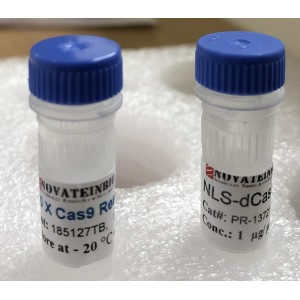
Description
For molar concentration and other related production information, please refer to:
Nuclease deficient Cas9: Possess no cleavage activity due to D10A and H840A mutations. Has the ability to bind to DNA.
1. Deactivated CRISPR Associated Protein 9 for Minor-Allele Enrichment in Cell-Free DNA Amin Aalipour et al. Clinical Chemistry 2018 Vol. 64, Issue 2 p307-p916
2. Purified Cas9 Fusion Proteins for Advanced Genome Manipulation Jovan Mircetic et al. Small Methods 2017 1, 1600052
3. Disruptive non-disruptive applications of CRISPR/Cas9 Jonathan LSchmid-Burgk Current Opinion in Biotechnology December 2017, Volume 48 Pages 203-209
4. Efficient sequence-specific isolation of DNA fragments and chromatin by in vitro enChIP technology using recombinant CRISPR ribonucleoproteins Toshitsugu Fujita et al. Genes to Cells Volume 21, Issue 4 April 2016 Pages 370–377
5. High-throughput biochemical profiling reveals sequence determinants of dCas9 off-target binding and unbinding Evan A Boyle et al. PNAS 2017 May, 114 (21) 5461-5466
6.CASFISH: CRISPR/Cas9-mediated in situ labeling of genomic loci in fixed cells Wulan Deng et al. PNAS 2015 vol. 112 | no. 38 p11870-1187
Related Products
NLS-Cas9-NLS NLS-Cas9-EGFP NLS-Cas9(D10A)-2NLS nickase
dCas9 (D10A & H840A) NLS-dCas9-NLS Biotinylated NLS-dCas9-NLS
dCas9-SBP NLS-dCas9 -EGFP-NLS LbCas12a (Cpf1) Nuclease
eSpCas9(1.1)-3NLS SpCas9-HF1-3NLS Cas9 ELISA kit
Cas9 Monoclonal Antibody Cas9 monoclonal antibody, biotinylated
Data Sheet
| Applications | Recombinant dCas9 (D10A & H840A) protein is suitable for use in imaging of genomic oci in living cells and fixed cells as well as for gene expression regulation. |
| Background | The functions of CRISPR (Clustered Regularly Interspaced Short Palindromic Repeats) and CRISPR-associated (Cas) genes are essential in adaptive immunity in select bacteria and archaea. CRISPR uses a Cas9 protein to recognize DNA sequences, with target specificity solely determined by a small guide (sg) RNA and a protospacer adjacent motif (PAM) Upon binding to target DNA, the Cas9-sgRNA complex generates a DNA double-stranded break. Based on this RNA- guided nuclease activity, CRISPR has been showed to be a powerful tool in editing the genomes of a broad range of organisms. Furthermore, a repurposed, nuclease- deactivated Cas9 (dCas9) protein has been used to regulate endogenous gene expression and labeling of genomic loci in living and fixed cells. |
| Concentration | 1 µg/ µL, 6.26 µM |
| Formulatin | Recombinant dCas9 (D10A & H840A) protein expressed in E. coli supplied in a buffer of 10 mM Tris-HCl (pH 7.4), 0.1 mM EDTA, 1 mM DTT, 300 mM NaCl, and 50% (v/v) Glycerol. |
| Host/Source | E.coli |
| Purity | Greater than 90% as determined by SDS-PAGE. |
| Pysical Appearance | Sterile filtered colorless solution. |
| Sequence | Mutated CRISPR-associated endonuclease Cas9 (amino acids 1 to 1368) with D10A & H840A (Uniprot: Q99ZW2 for Cas9). To facilitate nuclear entry, two nuclear localization signal sequence (NLS) are fused to both N- and C-terminal of dCas9 protein. |
| Size | 50 µg, 313 pmo, with Reaction Buffer |
| Storage | ‐70°C. Avoid freeze thaw cycles. |
| Storage and Stability | Store at 4°C if entire vial will be used within 1-2 weeks. Store, frozen at -20°C for longer periods of time. For long term storage it is recommended to add a carrier protein (0.1% HSA or BSA). Avoid multiple freeze-thaw cycles. |
| Storage buffer | 10 mM Tris-HCl (pH 7.4), 0.1 mM EDTA, 1 mM DTT, 300 mM NaCl, and 50% (v/v) Glycerol. |